
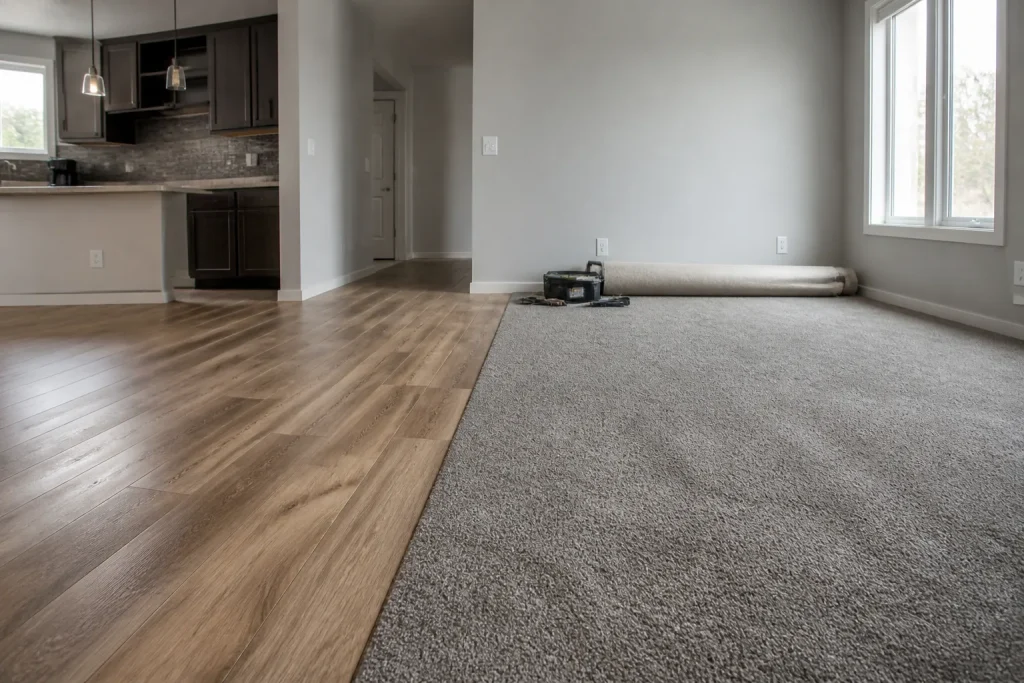
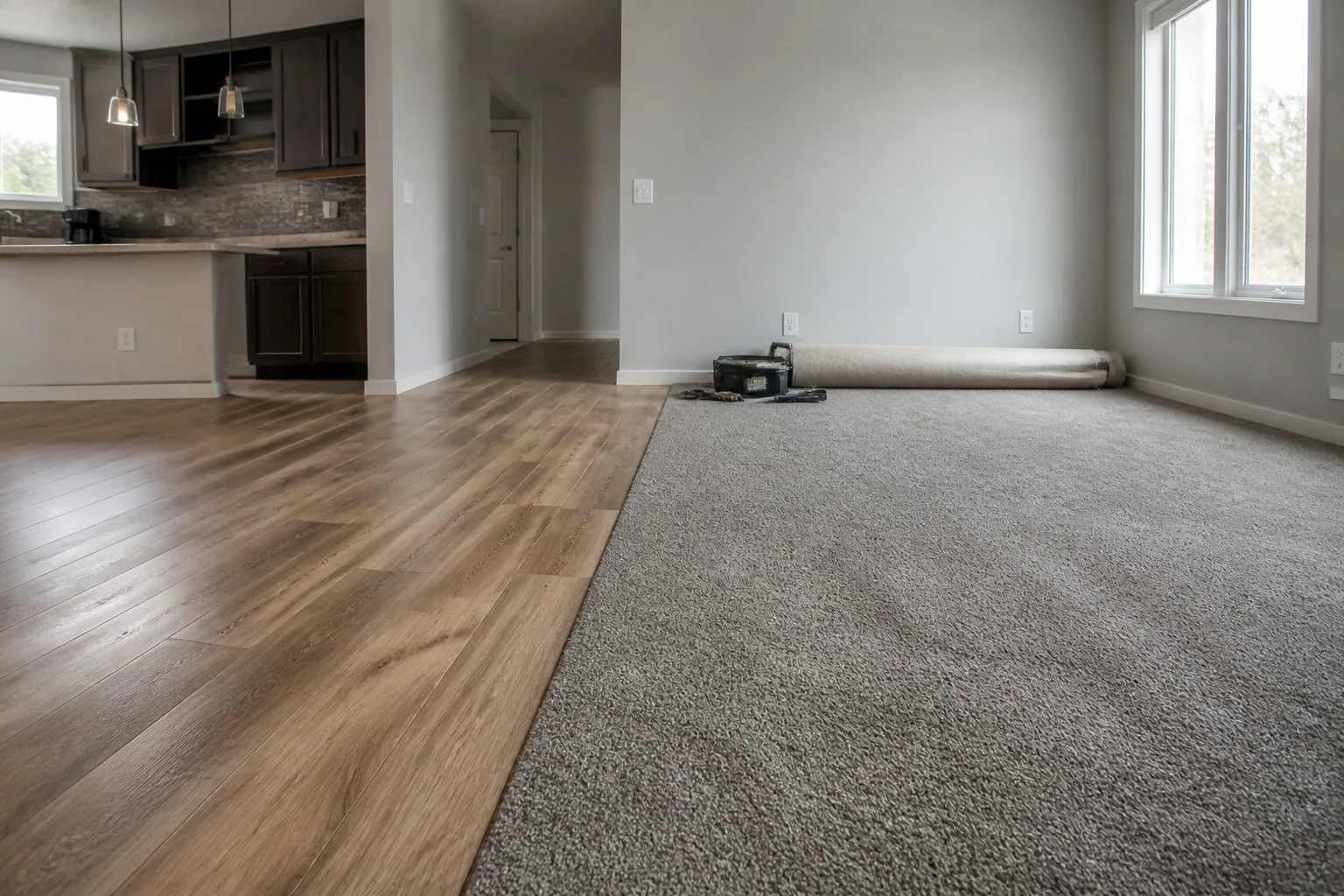
Carpet or Hard Flooring for a Bedroom: How to Decide
Hard flooring is the dominant look in bedrooms right now, and it photographs beautifully. But the calls we get most often about bedroom floors aren’t about appearance. They’re about cold feet at 6am, a hollow echo that makes the room feel like a hallway, and street noise that wasn’t noticeable before the carpet came up. This isn’t a taste question dressed up as one. It’s a question about how the room is used, who sleeps in it, and what’s underneath it.
Short answer: carpet wins for most bedrooms on comfort and sound, hard flooring wins on ease of cleaning and dust control, and the right call depends on the sleeper, the subfloor, and the noise path below. If you’d rather have a specialist walk your actual room before you commit, call (844) 560-5320.
Key Takeaways
- Carpet absorbs sound in the room and cuts impact noise to the floor below. Hard floors don’t, unless you add acoustic underlayment.
- A rug over hard flooring is not the same as wall-to-wall carpet, especially on comfort and acoustics.
- Allergy considerations cut both ways. Carpet traps allergens; hard floors keep them airborne. It depends on the allergy.
- Kids and older family members face a real slip risk on hard flooring right beside the bed.
- Slab-on-grade bedrooms in Boulder City feel different underfoot than wood-framed floors, and that changes the answer.
Why Carpet Is the Quieter Choice for a Bedroom
Carpet reduces impact noise transmission to the floor below and softens airborne sound inside the room itself. That matters more than most buyers expect. A bedroom is the one room in the house where noise control is the whole point. Footsteps, a dropped phone, a dresser drawer sliding shut at midnight, all of it lands softer on carpet than on a hard surface.
Hard flooring without acoustic underlayment essentially turns the bedroom into a drum. Sound bounces off the surface and travels through the structure. If you’ve ever slept in a hotel room with tile floors and heard the room above you roll a suitcase across it, you know the sound. Homes behave the same way.
In our experience, the households that call us back about noise are almost always bedrooms where carpet came out and nothing went down to replace the acoustic function. Laying a hard floor and calling it done treats the bedroom like a kitchen. It isn’t one.
If quiet matters, two options work. Full carpet.
- Carpet over a quality pad gives you the broadest sound control, and brands like Shaw and Mohawk both make bedroom-grade carpet.
- Hard flooring plus acoustic underlayment gets you partway there. It’s a real improvement over bare hard floor, but it’s still a different product than carpet underfoot.
Either way, decide on the acoustic goal before you pick the material. Retrofitting underlayment after the fact means pulling the floor.
Is a Rug Over Hard Flooring Just as Good as Carpet?
No. A rug over hard flooring is not equivalent to wall-to-wall carpet on comfort or acoustics, and it introduces a few practical wrinkles worth knowing before you commit.
A rug only covers part of the room, so sound bounces off the exposed hard surface before it ever reaches the rug. The impact noise that travels to the floor below also depends on the rug pad underneath, not the rug itself. A thin pad or a rug with no pad does very little for either problem.
There’s a maintenance factor that gets skipped in a lot of bedroom flooring advice. In a dry desert climate like Boulder City’s, a rug over hard floor traps fine dust and grit underneath, and the hard floor underneath it is harder to clean than an exposed floor would be. Pull up the rug every so often and vacuum both sides, and treat the rug pad as a wear item. A rug that lives in one spot for years collects what you can’t see.
If you’re deciding between the two, ask yourself whether you want to lift the rug to clean under it. If the answer is no, carpet may actually be the lower-effort choice for a bedroom. Rugs are great for flexibility and design. They aren’t a substitute for the acoustic and comfort work carpet does.
Does Carpet Help or Hurt With Allergies?
Both, depending on the allergy. This is where the debate usually goes wrong. Carpet traps allergens in its fibers, which keeps them out of the air but means they have to be removed by vacuuming. Hard flooring keeps allergens on the surface where they’re easier to wipe up, but they can become airborne more easily and stay circulating.
The distinction that matters is between what’s in the air and what’s in the floor:
- Dust and general indoor allergens: carpet holds them in place. That’s good for air quality if you vacuum regularly with a good filter, less good if you don’t.
- Dust mites: carpet is a place they live. Hard flooring gives them less to work with, which is a point for hard floors in a bedroom.
- Pet dander: carpet traps it, which helps the air quality but means you’ll be vacuuming often. Hard flooring is easier to clean up, but dander sheds into the room either way.
We’re flooring specialists, not allergists, so we won’t tell you one material cures anything. What we can tell you is that the “hard floors are always better for allergies” line is too simple. Ask what the person is sensitive to, then match it.
For Boulder City bedrooms, the practical middle ground is a hard floor with a low-pile rug beside the bed. You get the easy clean, plus something soft underfoot where you actually stand.
The Age-of-Occupant Question Nobody Asks
Slip and fall risk near the bed is a real safety variable on hard flooring, and it rarely comes up in bedroom flooring comparisons. A bedroom is where someone gets up in the dark, sometimes disoriented, sometimes in a hurry. A hard floor gives you nothing to grip.
For a child’s bedroom, the risk is tumbles and hard landings. A toddler who climbs out of the crib onto a tile or hardwood floor next to the bed is a different fall than one onto carpet. For an older family member, the risk is a night-time trip to the bathroom on a slick floor in bare feet.
If either of those applies in your home, the choice points toward carpet, or a hard floor with a generous bedside rug placed exactly where the first step lands. Neither is a cure, and neither replaces a nightlight or a clear path. But it’s a factor worth weighing alongside how the room looks, and it’s a good reason not to treat the flooring decision as purely design.
The Subfloor Question: What Works Under the Room Changes the Answer
The subfloor under a bedroom changes the hard-floor calculus, and it’s the step that gets skipped when the conversation starts and ends with color. A concrete slab bedroom in a Boulder City home behaves differently from a bedroom over a wood-framed subfloor, and both affect how a hard floor will feel.
A slab-on-grade bedroom is in direct contact with the earth, so it feels cooler underfoot than a room over a framed floor. That’s a bigger deal in a desert climate, where mornings start cool even after a hot day. Hard flooring over a slab has less of a cushion and more of a chill. A concrete slab can also transmit moisture from below, and that has to be handled correctly during installation no matter what material goes down. We always want to see the slab and the moisture conditions before recommending a floor.
A wood-framed subfloor is warmer and has some give to it, which makes hard flooring feel a little less harsh. It also has its own acoustic behavior, and it can carry impact noise to the room below more readily.
Before you decide between carpet and hard flooring, we want to know:
- What’s under the subfloor (slab or framed)?
- Where’s the moisture coming from, and is it under control?
- What’s below the bedroom, and who’s sleeping there?
- How cool does the floor feel underfoot in the morning?
Those four answers decide more than a color swatch will. If you’re in Boulder City and your room sits over a slab, we’d rather check it at the estimate than discover a moisture issue after installation. A floor that starts out right stays right longer.
When to Call a Pro
Some decisions are easy. Carpet over a stable subfloor with no moisture concerns is straightforward. The calls that need a professional eye are the ones with a wrinkle in them. Slab moisture you can’t identify. A framed floor that’s bouncy or squeaks. A bedroom where you want hard flooring but aren’t sure how much acoustic underlayment it needs. A pulled-up carpet that reveals a subfloor in worse shape than expected.
Installing a floor is not a DIY project we’d recommend for a room you sleep in every night and can’t easily redo. If you’re weighing carpet against hard flooring and want a straight answer based on your room, that’s a conversation worth having with someone who installs both. Our technicians have up to 10 years of experience and have seen the subfloor scenarios. We can tell you which materials work with what’s under your floor instead of guessing from a sample book.
If you’re ready to start with a real recommendation, call (844) 560-5320 for a free estimate. We answer 24/7, and we dispatch from 7am to 7pm, Sunday through Friday.
Related services in Boulder City
Bedroom flooring is one room. If you’re planning a whole-home refresh, our Boulder City Flooring team can help you coordinate the material choice across rooms so the transitions between floors make sense. If you’ve settled on carpet for the bedroom, our carpet installation service covers the full room. For a bathroom or a hard-floor bedroom, our tile flooring installation service handles both. You can see the full range of what we do for Boulder City homeowners on one page.
What happens when you call
- 1
A real person answersNo phone trees – you reach a local pro.
- 2
You get an upfront price rangeHonest numbers before anyone is dispatched.
- 3
A background-checked tech heads outLicensed & insured, dispatched right away.
- 4
You approve before work beginsNothing starts until you say go.
The Bottom Line
Carpet is the better choice for most bedrooms when comfort, sound, and slip safety are the priorities. Hard flooring is the better choice when ease of cleaning, dust control, and a specific design goal matter more. A rug over hard flooring gets you partway there but doesn’t replace what carpet does. And none of it matters until you know what’s under the floor.
So check the subfloor and the noise path below before you pick a color. If you’re weighing it in Boulder City, that’s a conversation we welcome. Call (844) 560-5320 for a free estimate. We answer 24/7, and we dispatch from 7am to 7pm, Sunday through Friday. No showroom, no sales floor pressure, just a specialist who does this for a living and will tell you straight which way your bedroom points.
Frequently Asked Questions
Carpet is usually better for a bedroom if quiet and comfort are the priority; hard flooring is better if easy cleaning and dust control matter more. The deciding factors are who sleeps in the room, how it’s used, and what’s under the subfloor. Call (844) 560-5320 for a free estimate if you’d like a recommendation based on your room.
No. A rug covers only part of the room, so hard flooring still reflects sound, and acoustic performance depends on the rug pad rather than the rug alone. A rug also traps dust and grit underneath it in a dry climate like Boulder City’s, which makes it more maintenance than carpet. Call (844) 560-5320 if you’d like to compare options for your bedroom.
It depends on the allergy. Carpet traps allergens and keeps them out of the air, but it requires regular vacuuming, and dust mites can live in it. Hard flooring keeps allergens on the surface, which is easy to wipe up but easier to stir into the air. Neither is universally better; match the material to the specific sensitivity. Call (844) 560-5320 for a free estimate.
Cost depends on the material, the room size, and the condition of the subfloor, which is why we price per job with a written estimate rather than a per-room figure. We’ll measure the room, check the subfloor, and put the price in writing so you know what you’re committing to. Call (844) 560-5320 for a free estimate.
Written by the team at Boulder City Flooring.
Need Flooring Help?
Call Boulder City Flooring - licensed & insured, with free written estimates in Boulder City.
(844) 560-5320